The BHC Bulletin

Uncategorized

Viewing posts from the Uncategorized category

Ads, Netflix, Ads and Netflix plus anti-social media.

The BHC Bulletin.

Picture: Unsplash / Julian Hochgesang

So we are back — welcome again to the BHC Bulletin, www.beechhillconsultancy.com an update on the more interesting, but less reported recent media stories.

In this edition….

Why Netflix ads aren’t impressing the audience.

Look at the crazy age bias in the advertising industry.

US school district suing social platforms for alleged mental health damage

And

See how revenue from pay TV revenue is due to drop by the not insignificant figure of £5bn in the next few years.

And let’s look at that first:

Just review at this chart by Digital TV Research…
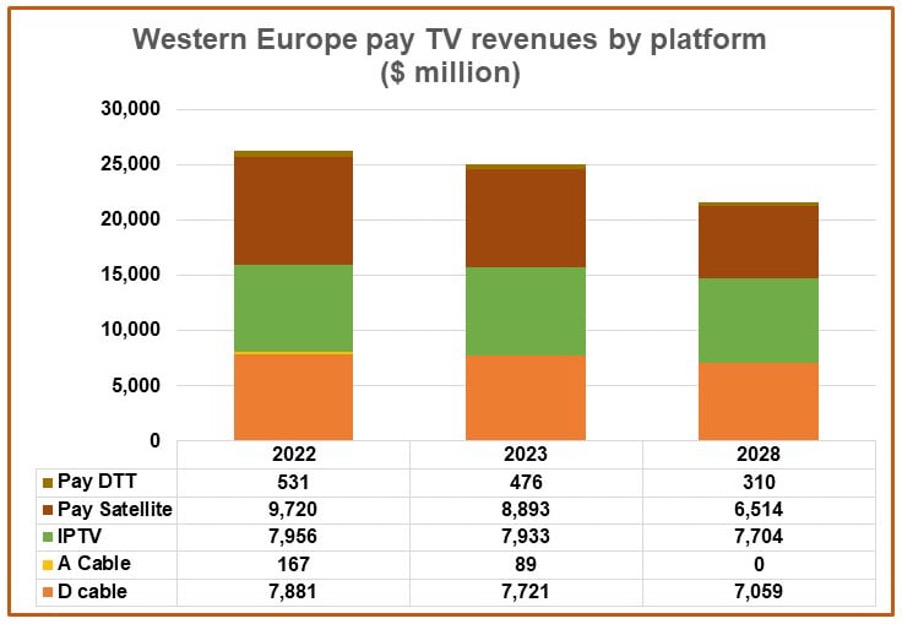
If I was a satellite operator I’d be a little concerned. In the industry jargon it’s called “cord-cutting” — defined as “the practice of canceling a pay television subscription or landline phone connection in favour of an alternative internet-based or wireless service.”

In my house, we have done that this month too — we have ditched a pay satellite service for the first time in 30 years and now have IPTV via a box and smart tv. (and we save approx. $£€100 a month at the same time!)

We are clearly not alone….

Digital TV Research says pay TV revenues in Western Europe will decline by nearly US$5bn between 2022 and 2028. That’s an 18 percent drop!!!

Streaming sites such as Netflix and Amazon Prime will surpass satellite TV in 2025 to become the most lucrative platform.

“IPTV revenues overtook digital cable in 2022,” said Simon Murray, principal analyst at Digital TV Research speaking to C21. “#iptv will surpass satellite television in 2025 to become the most lucrative platform.”

Much more here: https://www.c21media.net/news/western-european-pay-tv-revenues-forecast-to-drop-by-almost-5bn-by-2028/

Diversity deficit

As a CEO in media for many years it was apparent to me that the people making TV were in no way representative of the people watching it.

And I made many efforts to align age, diversity and background of the production community I worked with to align with the audience. Now the advertising agency has woken up and realised the same….

Over 50s make up a large proportion of UK society and household consumer spending, but less than 7% of advertising workforce.

The IPA (Institute of Practitioners in Advertising) published its latest census the other week. It shows major progress on many aspects of diversity and inclusivity.

“In terms of age…not so much. The percentage of the over 50s in the ad industry languishes at 6.5%…no change.” Say the editorial in The Media Leader .

In the UK, over 50s make up just under 40% of the population and account for roughly 54% of all household consumer spending.

The full editorial by Glen Wilson is worth a read:

https://the-media-leader.com/the-age-thing-why-doesnt-the-average-ad-professional-seem-to-care

Here is the Netflix story for this blog (I always have one it seems)

Despite the fact linear TV programming has over 13 minutes of ads each hour, 2.5 times than the Netflix’s ad-supported tier, 49 per cent of ‘Basic with Ads’ subscribers found the 5 mins Netflix carried to varying degrees heavy, with 17 per cent seeing it as excessive, according to analyst firm Aluma Insights.

“Having to watch only five minutes of ads per hour is a delightful reprieve from the much heavier ad loads of linear TV,” said Michael Greeson, founder and principal analyst at Aluma speaking to Advanced Television. “But linear TV is not necessarily the advertising benchmark for today’s multi-source viewers, a growing number of which came of age watching ad-free streaming video services such as Netflix.”

Aluma is in the last stages of a new report on how users perceive the ad loads of premium ad-supported SVoD service users, including Netflix, Hulu, HBO Max, Paramount+, Peacock, and ESPN+, and that examines the relationship between cancellation proclivities and ad load perceptions.

See more about the research at:

(Anti) Social media

As Governments around the world start to legislate to protect young people (and the rest of us) from harmful content on social media.

Six Western Pennsylvania school districts have joined the Pittsburgh city schools in suing social media platforms on behalf of students, saying Meta, Instagram, Snapchat and others are harming the mental health of America’s youth in the name of profit.

The districts filed identical 107-page complaints in federal court in Pittsburgh last week on the grounds of negligence, racketeering and other counts.

The suits say the social media platforms direct content to minors that is “harmful and exploitive,” such as instigating eating disorders, instigating vandalism and encouraging self-harm.

The defendants are Meta, Instagram, TikTok, Facebook, ByteDance, Alphabet, Google, Whatsapp and others.

More details on this are found at:

That’s it for this BHC Bulletin — for expert media, business and comms advice and questions Beech Hill Consultancy is here to listen.


Essential viewing – Netflix, not Apple winning the viewing wars.

News from media, comms, and business – it’s the latest edition of the BHC Bulletin. 

This month’s highlights for less reported stories in media-ville include what the audience voted as essential viewing, how a crowded marketplace is confusing consumers plus ITV to close Kids linear channel in favour of streaming.

Regular readers of the BHC Bulletin will know I am both a  fan and dumbfounded by Netflix – a fan as a disruptor, dumbfounded at the level of debt and the level of investment in a content led product.

This month – research firm Aluma Insights have found two-thirds of US Netflix buyers view the service as indispensable. Indispensable? That’s big claim.

More than half of subscribers considered the service essential instead of just nice to have.  Hulu and Disney+ were the only other services to get more than 50% approvals.

An interesting point was that the (almost) equally hugely spending Apple TV+, and Peacock were found to be the least essential for households..

The full article is here:

and still with SVoD – it’s a crowded marketplace. Differentiation of service is needed as audience confusion is high.

The streaming wars have of course created a crowded marketplace, 

In their Evolution of Video Branding survey from Hub Entertainment Research shows what many of us knew for a long time – viewers find it tough differentiating the brands in the SVoD world and instead turn to “known” content or brands to help 

41 percent of viewers say they have signed up for a platform just to watch one specific show (up from 35 percent two years ago).

Advanced Television described this simply, “When lost in a sea of content, viewers look for what’s familiar: New shows based on familiar characters or histories have a leg up in the discovery process.”

David Tice, senior consultant to Hub and co-author of the study states: “Viewers have not lacked in choice of services and content over the past few years. But this can be a two-edged sword for content providers, as the immense volume just makes it hard for viewers to remember what is different about each service.”

To read more:

In the UK, ITV is to close its CITV broadcast channel this autumn.

Instead – the broadcaster announced a new streaming hub for kids programming, ITVX Kids, which will be aimed at 6-12s and launches in July.

(ITV will maintain the LittleBe pre-school segment on ITVBe and will offer some children’s content in the early mornings on ITV2 from September.)

This follows other kids’ services closing in recent years including a whole raft of Disney services.

It’s clear that streaming will be the default delivery mechanism that feels natural for those coming through as the viewers of tomorrow.

This will leave policy makers with big choices regarding use of spectrum, the value of PSB channels and how to give prominence to news and “public purpose” programming in a world when navigation is far more complex than linear services.

Here’s the full story about ITV kids:

https://www.radiotimes.com/tv/entertainment/citv-channel-close-itvx-kids-newsupdate/

And finally (guest written by BHC’s Chris Davis)

Well, it’s impossible to write about the media this month and not mention the trouble of the BBC with one of their biggest stars, Gary Lineker.

I have no intention of repeating the pages of comment here – only to point out the bigger issue, that every time the BBC faces external pressures from politicians and negative press, alas much of it self-inflicted, then trust in the business falls.

For the first time in my career the effect has mean that – perhaps only temporally – but who knows, that the commercial channel ITV’s new is now more trusted by the audience than the BBC’s.

The full details of the poll carried out by The Observer/The Guardian are here:

https://www.theguardian.com/media/2023/mar/18/itv-news-is-more-trusted-than-bbc-after-lineker-row-and-sharp-controversy

But the key issue is that policy failures can lead to real reputational damage and all organisations need to be aware of that. Clear comms are required and staff, contractors and suppliers need to understand what is expected from their service and their interaction with third parties – whether in the real world or the digital / social platforms.

The BBC has commissioned the highly respected former Disney and ITN exec John Hardie to lead a review into social media guidelines for freelancers – expect more coverage, and muck-racking when that report is issued later in the year.

That’s it for now, more next month. And for all your leadership communications and media development needs, please get in touch with Beech Hill Consultancy. 

www.beechhillconsultancy.com

The February BHC Bulletin

This month’s highlights for less reported stories includes Armageddon predictions for legacy US media companies, good news for television show participants, and a wake-up call for corruption in the UK (perhaps).

Image: Unsplash. Glenn Carstens-Peters

News from media, comms, and business – it’s the February edition of the BHC Bulletin. 

It is all doom and gloom in the streaming world.

Streaming costs – it costs in content, it costs in distribution and it costs in marketing. It also generates less than the traditional advertiser funded model of linear broadcasting (on a territory by territory basis). The whole industry understands this – but has been pushing against the laws of economics for too long!

 In a research document by boutique media analysts MoffettNathanson they warn that “that after years of effectively printing money with traditional services, a pivot to streaming to follow Netflix will lead many players to face the reality that they can no longer afford to chase profits that do not exist”.

I’m going to quote directly from RapidTV News here:

“Rather than being the new sliced bread, MoffettNathanson insists investors and media company executives have accepted that streaming is, in fact, not a good business, at least not compared with what came before.”

“The study, US Media: Hurtling Towards Act 3, shows that in its third stage of evolution the streaming market can now be seen as one where even though subscribers have shown up en masse, profits have remained elusive and cashflows are for media firms, said the analyst bluntly, “sorry ghosts of their former selves” and where balance sheets are loaded with debt in a higher interest rate environment.”

The report continues “great companies will have to face the reality that they can no longer afford to light money on fire chasing profits that do not exist. For some this simply means a new age of rationalisation. For others, acquisition may prove the only salvation. For all, the present state of affairs cannot continue.”

James Dolan, interim executive chairman of AMC Networks is quoted in the report. He says, “It was our belief that cord-cutting (that’s subscribers dropping services from cable or satellite operators) losses would be offset by gains in streaming. This has not been the case. We are primarily a content company and the mechanisms for the monetisation of content are in disarray.”

At BHC we think it’s highly likely there will be consolidation in the streaming marketplace. In the US every broadcaster and some prod-cos brought out their own Player. Many won’t last much longer. The question is when will Apple or Amazon gobble up the key brand players…..and that includes even Netflix which BHC would venture will have a new corporate home in the next few years.

In Europe it’s a similar picture with Screen Daily reporting that the French joint venture, Salto is on the verge of closure. (And since writing -= has now been confirmed will close)

Salto was previously owned by a trio of France’s biggest broadcasters – France Télévisions, TF1 and M6. (TF1 and M6 exited last year when their merger collapsed). Salto had 800k of subscribers – so hardly small scale.

And in the UK it’s clear that the ITVX streaming platform is the latest push to show how digital PSB player ITV has become. But the question will be that by increasing digital revenue, can it offset the decline in linear spend?

Media and care of contestants – calling interested psychologists.

Some UK media companies have come in for criticism over the years for their perceived lack of duty of care, so positive news, is that ITV and the BBC have partnered to expand the pool of registered psychologists with experience of working in television. 

The two businesses are developing a continuing professional development programme that has been accredited by the British Psychological Society. 

The programme is aiming to introduce more psychologists to the challenges and stresses of media production so they can support ITV and BBC programmes in their duty of care towards contributors.

David Osborn, Chief People Officer at ITV, said: “Whether it’s those behind the screen or in front of it, people are at the core of ITV and making sure that our people are properly looked after is something we’re committed to doing.”

Simon Adair, Director of Safety, Security & Resilience, BBC, commented: “As a responsible broadcaster, ensuring the health, safety and wellbeing of the contributors to our programmes is of the utmost importance. I’m confident this partnership will strengthen our whole industry by increasing the pool of expert psychologists available to us, ultimately enhancing our ability to protect and support those taking part in productions.”

Corruption Index isn’t kind to the UK.

I’m finishing on a story that’s not media or comms related but, I find it worrying that the UK has slipped to 18th place in the global corruption index.

Sky News reported, “The UK has fallen down the global Corruption Perceptions Index (CPI) to its lowest ever score as a report warned “slipping standards are being noticed on the world stage”. 

The UK joins a less than stellar cast of only five countries seeing their year-on-year scores drop by five or more points: Qatar, Myanmar, Azerbaijan and Oman. Not necessarily a list you would want to be associated with.

The CPI is compiled by Transparency International which uses impartial surveys from experts and business leaders to rank countries by the perceived level of corruption in their public sectors.

Chief executive Daniel Bruce is quoted as saying the drop in UK standing is a “powerful indictment of a recent decline in standards in government…experts are concerned about insufficient controls on the abuse of public office and increasingly view corruption and bribery as a real issue in Britain. This is the strongest signal yet that slipping standards are being noticed on the world stage.”

The Sky News report goes on “The UK now ranks 18th alongside Belgium and Japan and behind Uruguay, Iceland and Estonia.

Denmark tops the index, while South Sudan, Syria and Somalia, remain at the bottom”.

Reputation is hugely important at every level  – BHC works hard with clients to ensure a strong reputation for individuals as well as companies. It’s an old, but very true saying, that reputation takes years to build and minutes to lose. 

Perhaps in a social media, always on environment – that minutes to lose, could become seconds. 

I don’t usually end on a downer – but the fall in the UK reputation rating is something everyone should be concerned about.

The ratings for Netflix are in…

…and they are not as high as you might think.

Credit: Unsplash. Oscar Vargas.

These days for any business data is king, queen and often the keys to the castle too – in the media sector one of the big data secrets has just been exploded.

For years only Netflix new the viewership to their shows – now in the UK at least – those figures are out.

For many of us, especially those who have made a career in commissioning and exec producing ratings winners, there are few surprises. On any given night – linear (that’s old fashions) tv usually wins out, but the real deal with Netflix is the longevity of its shows in the on-demand digital streaming world. 

It’s no wonder the traditional broadcasters are racing to keep up and roll-out new players, better tech and more on demand content.

As Advanced Television very nicely put it:

While Netflix and other streaming services have clearly established themselves within the television-viewing ecosystem, broadcasters continue to account for the lion’s share of viewing in the UK. Across 2022, broadcasters’ linear channels and on-demand services have accounted for around two-thirds of all identified viewing, while SVoD/AVoD services comprise about one-sixth of all viewing. The average daily viewing time to broadcasters’ services was 159 minutes in September 2022, and the average for SVoD/AVoD services was 36 minutes per day.

These are key figures when it comes to Netflix launching its advertising funded layer – advertisers want to see the eyeballs and the demographics they are buying in a format that compares easily where they are placing their spend. In reality Netflix had little choice but to join the industry audience measurement system. Disney has been there for a while already.

It’s tough out there for broadcasters and streamers – in my post of September 30 I showed how much value major media tech companies had lost in value last year (and it hasn’t got any better for them since then).

Netflix face many battles including losing key shows to streaming services owned by the broadcasters – services that didn’t exist when Netflix first launched.

For example, as Ampere Analysis recent work shows – in August 2015 Netflix was holding 72 per cent share of the 100 most popular SVoD titles in the US. But in the last seven years, Netflix has seen a steady decline to under 30 per cent of key titles

Josh Rustage, an analyst at Ampere Analysis says Netflix sure knows how to create its own hits now though “However, despite the declining proportion, Netflix still has a higher share than any other SVoD platform and boasted five of the top ten most popular titles in August 2022,” he said. “This can partly be attributed to its focus on producing original content and acquiring high-quality exclusives. Netflix Originals such as Stranger Things and Bridgerton have held the top spot among all US SVoD titles for six out of the  first eight months in 2022.”

So back to the ratings where the second week of data has now been released. It includes all viewing measured by BARB (the UK version of Neilson) on a TV set, a desktop or laptop plus tablet and smartphone.

In the first week, Enola Holmes 2, with Millie Bobby Brown of Stranger Things fame playing the lead role, was their top SVOD show with 2.11 million viewers.

In week two the most-watched episode of Netflix’s new series of The Crown attracted 2.87according to BARB.

In the week beginning November 7, Netflix made up the top 22 most-watched SVOD shows in Barb’s list, with Amazon Prime Video’s Mammals starring James Corden the first non-Netflix show on the top SVOD show list.

But to put these figures into content – the most watched show of the week was ITV’s I’m A Celebrity…Get Me Out Of Here! which dominated the weekly top 50 shows, making up the top seven, with its most-watched episode reaching 11.3 million viewers across all devices on 21 November. 

That figure is a multiple of the Netflix figures and shows how this transparency may help the more traditional broadcasters and content owners win in the headline wars.

Obviously I’m a Celeb… and Strictly Come Dancing (the UK name for Dancing with the Stars) and the semi-final of Great British Bake Off, which were all major ratings winners that week, are appointment to view television.

It would be good to see the data for drama / scripted content stripped out of the research and then we can truly understand how the conventional players and the streamers are competing on the new, leveller playing field.