
The BHC Bulletin.

So we are back — welcome again to the BHC Bulletin, www.beechhillconsultancy.com an update on the more interesting, but less reported recent media stories.
In this edition….
Why Netflix ads aren’t impressing the audience.
Look at the crazy age bias in the advertising industry.
US school district suing social platforms for alleged mental health damage
And
See how revenue from pay TV revenue is due to drop by the not insignificant figure of £5bn in the next few years.
And let’s look at that first:
Just review at this chart by Digital TV Research…
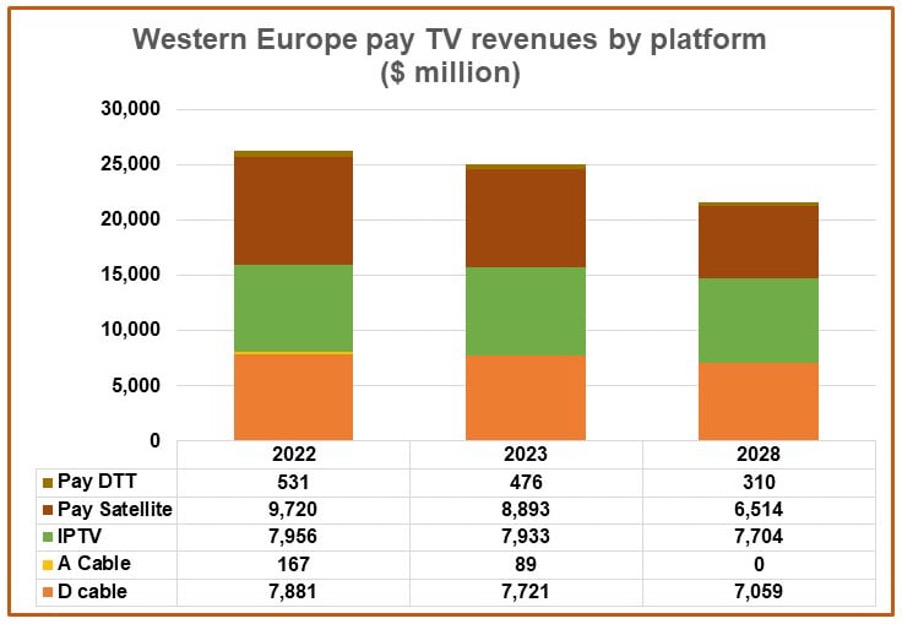
If I was a satellite operator I’d be a little concerned. In the industry jargon it’s called “cord-cutting” — defined as “the practice of canceling a pay television subscription or landline phone connection in favour of an alternative internet-based or wireless service.”
In my house, we have done that this month too — we have ditched a pay satellite service for the first time in 30 years and now have IPTV via a box and smart tv. (and we save approx. $£€100 a month at the same time!)
We are clearly not alone….
Digital TV Research says pay TV revenues in Western Europe will decline by nearly US$5bn between 2022 and 2028. That’s an 18 percent drop!!!
Streaming sites such as Netflix and Amazon Prime will surpass satellite TV in 2025 to become the most lucrative platform.
“IPTV revenues overtook digital cable in 2022,” said Simon Murray, principal analyst at Digital TV Research speaking to C21. “#iptv will surpass satellite television in 2025 to become the most lucrative platform.”
Much more here: https://www.c21media.net/news/western-european-pay-tv-revenues-forecast-to-drop-by-almost-5bn-by-2028/
Diversity deficit
As a CEO in media for many years it was apparent to me that the people making TV were in no way representative of the people watching it.
And I made many efforts to align age, diversity and background of the production community I worked with to align with the audience. Now the advertising agency has woken up and realised the same….
Over 50s make up a large proportion of UK society and household consumer spending, but less than 7% of advertising workforce.
The IPA (Institute of Practitioners in Advertising) published its latest census the other week. It shows major progress on many aspects of diversity and inclusivity.
“In terms of age…not so much. The percentage of the over 50s in the ad industry languishes at 6.5%…no change.” Say the editorial in The Media Leader .
In the UK, over 50s make up just under 40% of the population and account for roughly 54% of all household consumer spending.
The full editorial by Glen Wilson is worth a read:
Here is the Netflix story for this blog (I always have one it seems)
Despite the fact linear TV programming has over 13 minutes of ads each hour, 2.5 times than the Netflix’s ad-supported tier, 49 per cent of ‘Basic with Ads’ subscribers found the 5 mins Netflix carried to varying degrees heavy, with 17 per cent seeing it as excessive, according to analyst firm Aluma Insights.
“Having to watch only five minutes of ads per hour is a delightful reprieve from the much heavier ad loads of linear TV,” said Michael Greeson, founder and principal analyst at Aluma speaking to Advanced Television. “But linear TV is not necessarily the advertising benchmark for today’s multi-source viewers, a growing number of which came of age watching ad-free streaming video services such as Netflix.”
Aluma is in the last stages of a new report on how users perceive the ad loads of premium ad-supported SVoD service users, including Netflix, Hulu, HBO Max, Paramount+, Peacock, and ESPN+, and that examines the relationship between cancellation proclivities and ad load perceptions.
See more about the research at:
(Anti) Social media
As Governments around the world start to legislate to protect young people (and the rest of us) from harmful content on social media.
Six Western Pennsylvania school districts have joined the Pittsburgh city schools in suing social media platforms on behalf of students, saying Meta, Instagram, Snapchat and others are harming the mental health of America’s youth in the name of profit.
The districts filed identical 107-page complaints in federal court in Pittsburgh last week on the grounds of negligence, racketeering and other counts.
The suits say the social media platforms direct content to minors that is “harmful and exploitive,” such as instigating eating disorders, instigating vandalism and encouraging self-harm.
The defendants are Meta, Instagram, TikTok, Facebook, ByteDance, Alphabet, Google, Whatsapp and others.
More details on this are found at:
That’s it for this BHC Bulletin — for expert media, business and comms advice and questions Beech Hill Consultancy is here to listen.